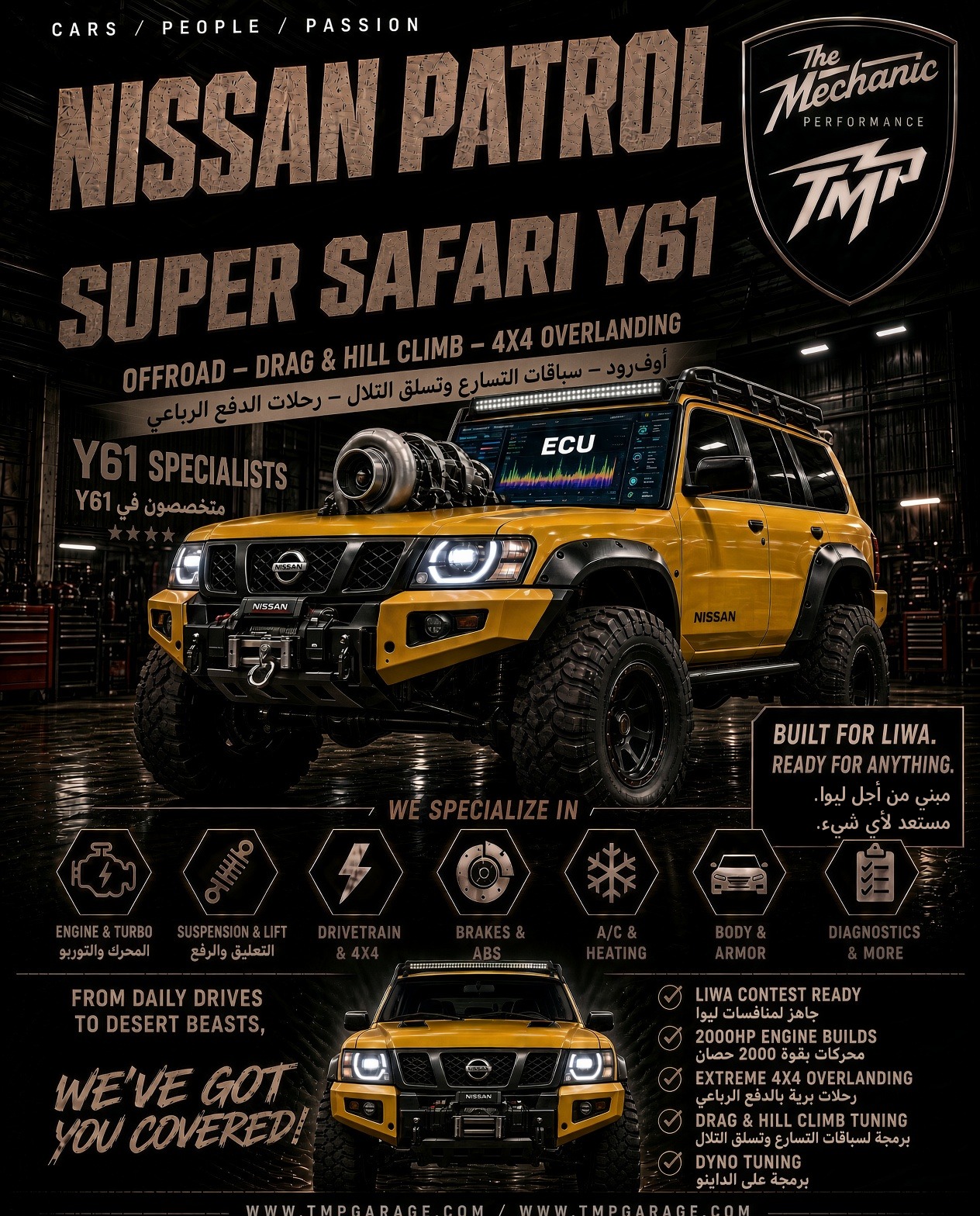
باترول سوبر سفاري Y61 بقوة تصل إلى 2000 حصان
في ورشة TMP في القوز، نجهّز باترول Y61 للرمال والتطعيس والرحلات البرية ومنافسات تل مرعب في ليوا: محرك مبني بالكامل، تيربو، نظام وقود، ناقل حركة، شاصي وقفص حماية، وبرمجة على الداينو. تواصل معنا عبر واتساب على 050 568 4007.
Why the Y61 rules the dunes
The Y61 Patrol, and the Super Safari in particular, has been the backbone of the UAE's desert scene for years. Its separate chassis, solid axles, long-travel potential and simple, strong layout make it the favourite starting point for everything from weekend dune bashing to the most extreme hill-climb machines.
At the top of that world sits the Moreeb hill climb at Liwa. Each winter, as part of the Liwa International Festival, heavily modified 4x4s attack Tal Moreeb, a dune of around 300 metres with a slip face close to 50 degrees. Builds there commonly run well over 1,000 HP, and the fastest go far beyond.
Not every Y61 needs 2000 HP
Before any spanner turns, decide what the car is for. We build Y61s in three broad directions:
- Desert and overlanding: reliability first, with suspension, protection, cooling, recovery points, storage and power systems, and enough performance for soft sand.
- Performance street and sand: a stronger engine and drivetrain that is still registrable and comfortable for daily use.
- Competition: hill climb and drag builds made for organised events, where power, traction and safety outweigh comfort and road use.
The rest of this guide covers the competition build, step by step.
Step 1: Set the target and read the rules
A 2000 HP build starts on paper. Confirm the class you will enter and its rules for engine type, fuel, weight, tyres and safety equipment, because they shape every decision that follows. Set a realistic power target, a budget and a deadline that leaves time for testing before the Liwa season.
Step 2: Strip and prepare the chassis
The car is stripped to the frame and inspected for cracks, rust and old damage. The chassis is then reinforced where competition loads concentrate: around the suspension mounts, steering box and engine and gearbox mounts. Weight that does nothing for speed comes out, and the components that remain are placed to get the balance right for a steep climb.
Step 3: Choose and build the engine
The Super Safari's 4.8-litre TB48 inline six is a strong base and a common choice for big power. Some builders swap in other six-cylinder or V8 engines. Whichever route you take, 2000 HP means the engine is rebuilt from the ground up:
- Block preparation, with machining and reinforcement suited to the cylinder pressure
- A forged or billet crankshaft, forged connecting rods and forged pistons
- Head studs and gaskets chosen for very high boost
- A ported cylinder head, competition camshafts, valves and springs
- A lubrication system that keeps oil pressure on steep climbs, often dry sump
Step 4: Forced induction
Most high-power six-cylinder builds use a large turbocharger. The turbo, manifold, wastegates and blow-off valves are sized together for the power target and how quickly the engine needs to respond on the launch. Intercooling is planned around the event: a hill climb run lasts only seconds, which changes what the cooling system has to cope with compared with a long desert drive.
Step 5: Fuel system
Big power needs big fuel flow. Builds at this level typically run methanol, ethanol blends or race fuel, depending on the class rules. That means high-flow pumps, larger injectors (often two per cylinder), a surge tank, braided lines and a safety fuel cell, all sized with margin so the engine never runs lean at full boost.
Step 6: Engine management and tuning
A standalone engine management system controls fuel, ignition, boost and launch. It allows boost control by gear and time, launch and anti-lag strategies, and detailed data logging. The ignition system is upgraded to fire reliably at high boost. Tuning is done in stages on the dyno, raising power step by step while watching temperatures, pressures and the air-fuel ratio.
Step 7: Cooling
Even short runs generate serious heat, and the car still has to idle, queue and drive in the desert between runs. A larger radiator, high-flow water pump, oil cooling and carefully routed airflow keep temperatures stable in the UAE climate.
Step 8: Drivetrain, the real challenge
Making 2000 HP is one thing; getting it to the sand without breaking parts is the harder job. The standard gearbox, transfer case and axles are not designed for it. Competition builds typically use a race-specification automatic or sequential gearbox, a strengthened or custom transfer case, custom driveshafts and heavy-duty axles, differentials and axle shafts.
Step 9: Suspension and steering
On a 50-degree slip face the car must stay straight, keep the tyres on the sand and survive the landing at the top. Long-travel suspension with competition shocks, correct geometry and strengthened steering with hydraulic assist give the driver control when the throttle is wide open.
Step 10: Tyres and wheels
Paddle-style sand tyres on beadlock wheels turn power into forward motion on loose sand. Tyre choice and pressure are tested and adjusted for the dune conditions on the day.
Step 11: Safety
At this power level, safety is not optional. A full roll cage, competition seats and harnesses, a fire suppression system, battery and fuel cut-off switches, and the right helmet and head-and-neck restraint protect the driver. Follow the organiser's safety and scrutineering requirements for your class exactly.
Step 12: Testing and shakedown
After the dyno, the car is tested in the sand. Data from each run shows where it loses time and what needs adjusting, from boost and launch settings to suspension and tyre pressure. This is where a build becomes competitive, so leave time for it before the event.
Plan your build early
The Liwa season arrives fast, and good builds take time. Whether you want a Y61 for the desert, for overlanding or to take on Moreeb, talk to us early so we can plan the stages, order parts and test properly.
Published 2026-11-11. General information about competition builds; specifications depend on your vehicle, goals and the event's rules. Competition vehicles are for organised events, not public roads.